


Why IB Diplomas Require Formal Recognition in Italy
The International Baccalaureate is one of the most widely adopted international education programmes in the world. According to official figures published by the International Baccalaureate Organization, more than 8,700 IB programmes are currently offered in over 6,000 schools across more than 160 countries, reaching nearly 1.95 million students aged between 3 and 19.
With such a global presence, it is increasingly common for IB diplomas to be presented to authorities in different countries for formal evaluation and recognition, both for academic purposes and for professional or administrative use.
In Italy, the way an International Baccalaureate diploma is recognised depends on both the purpose for which the qualification is used and the legal status of the school that issued it.
Under Italian law, the recognition of the International Baccalaureate is governed primarily by Law No. 738 of 30 October 1986, which acknowledges the IB diploma issued under the authority of the International Baccalaureate Organization in Geneva as a secondary school qualification within the Italian system.
However, the law introduces an important condition.
Only IB diplomas obtained from schools that have been formally recognised by the Italian Ministry of Education and included in the official ministerial list of authorised institutions are automatically considered equivalent to an Italian secondary school diploma for the purpose of university access.
These schools are identified through ministerial decrees issued under Article 2 of Law No. 738/1986 and subsequent implementing regulations, including Presidential Decree No. 164 of 2 August 2010. The Ministry maintains and periodically updates this list of institutions whose IB programmes are deemed compatible with the Italian educational framework.
When a diploma is issued by one of these recognised schools, the qualification is considered equivalent to an Italian diploma di istruzione secondaria di secondo grado for the purpose of enrolling in Italian universities.
The situation is different when the IB diploma has been obtained at a school that is not included in the ministerial list.
In such cases, the diploma does not benefit from automatic recognition. Instead, the holder must initiate a formal administrative procedure of equipollenza, through which the competent Italian authority evaluates the foreign qualification and determines whether it can be recognised as equivalent to an Italian secondary school diploma.
This procedure is usually handled by the Regional School Offices (Uffici Scolastici Regionali), which assess the documentation and the educational pathway before issuing a formal decree of recognition.
Another element frequently encountered in recognition procedures is the Dichiarazione di Valore issued by Italian diplomatic authorities abroad.
This document is often misunderstood. The Italian Ministry of Foreign Affairs clearly states that the Dichiarazione di Valore does not constitute recognition of a qualification. It is simply an official description of the nature, level and validity of the foreign diploma within the education system where it was obtained.
Its purpose is to provide information that assists the competent Italian authority in evaluating the qualification within the appropriate administrative recognition procedure.
A technical comparison issued through CIMEA tools often assists early framing of an IB Diploma. The ARDI “Statement of Correspondence” referenced in this case describes the Diploma of the International Baccalaureate as an upper secondary school qualification at EQF level 4, with a two-year duration and a pathway of 12 or 13 total years of schooling. The statement links 12–13 total years to direct access to first-cycle higher education, while 11 total years require compensatory measures under Italian entry procedures. The same statement also aligns general Diploma Programme requirements used in Italian admission practice, including at least 24 points across six subjects with 12 at Higher Level and positive completion of Theory of Knowledge, Creativity, Action, Service (CAS), and the Extended Essay.
The same ARDI statement also states clear limits: the document is automatically generated, provides a comparative correspondence opinion, does not certify authenticity, and does not itself produce legal effects in Italy.
Our Case Study Summary
The case involved an IB Diploma originally awarded in 2014, with a duplicate later issued in 2025. The final decree records both dates, distinguishing the original award date from the duplicate issue date.
The Dichiarazione di Valore produced in Geneva contained two issues described in the rectification request: an award date inconsistent with the original Diploma and an incorrect statement regarding the school’s position within the ministerial framework for recognised IB institutions. The rectification request anchored the correction narrative to official sources and supporting documentation held by the applicant.
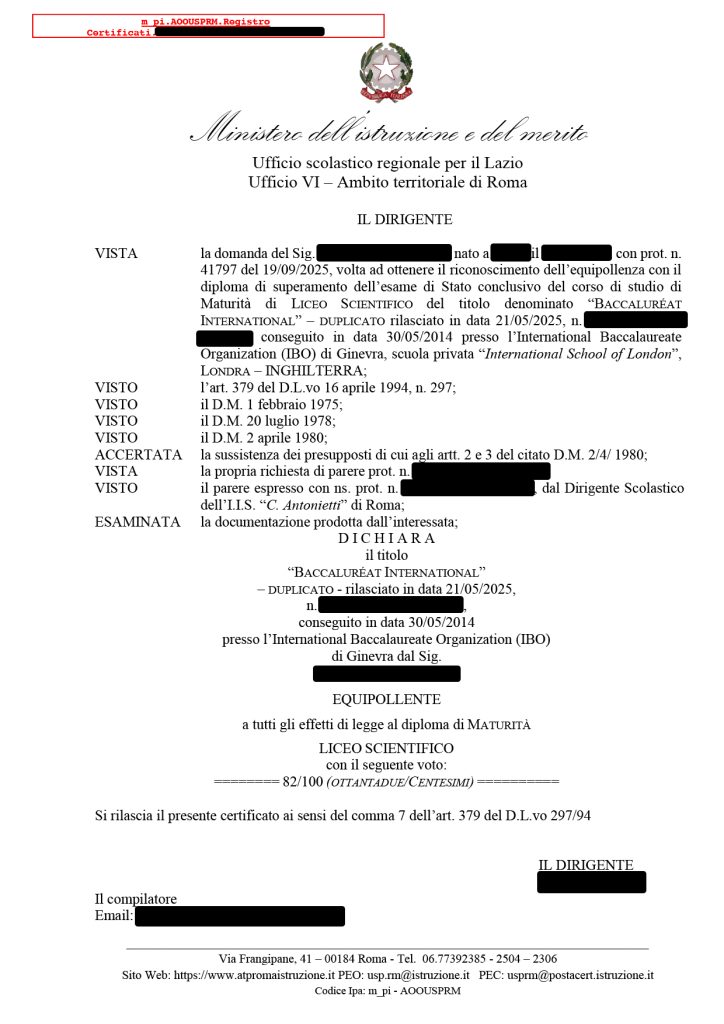
Once the documentation had been fully aligned and verified, the Regional School Office for Lazio (Ufficio Scolastico Regionale per il Lazio) issued the final decree of recognition.
The authority formally declared the International Baccalaureate diploma “equipollente a tutti gli effetti di legge” to the Italian Maturità corresponding to the Liceo Scientifico track. This Italian legal expression means that the foreign qualification is recognised with full legal validity and effects under Italian law (i.e. legally equivalent for all purposes to an Italian upper secondary school diploma).
The decree also converted the IB final score into the Italian grading system. In Italy, secondary school diplomas are graded on a 100-point scale, and the IB result was officially converted to a final grade of 82 out of 100.
Finally, the administrative deed clearly identifies the legal framework supporting the decision. Among the provisions cited are Article 379 of Legislative Decree No. 297 of 1994, together with the relevant ministerial regulations referenced in the “VISTO” clauses of the decree. These clauses list the legislative and regulatory sources that provide the legal basis for the recognition decision.
The International Baccalaureate diploma was formally recognised in Italy as equivalent to an Italian Scientific Upper Secondary School Diploma, with the final IB score officially converted into the Italian grading scale.
This recognition allows the qualification to produce full legal effects within the Italian system. In practical terms, the diploma can now be used for administrative purposes, including participation in public sector recruitment procedures that require the possession of an Italian secondary school diploma.
Reaching this result required the completion of the formal recognition procedure before the competent authority, which assessed the documentation and verified the equivalence between the international qualification and the corresponding Italian educational framework.
Once the evaluation was completed, the authority issued the final decree confirming the recognition of the IB diploma within the Italian legal and educational system.
Legal foundation and competence allocation
Italian law expressly recognises the IB diploma through Law 30 October 1986, no. 738. Article 1 frames the recognised IB diploma as an upper secondary diploma with legal value in Italy, and confirms equivalence for university admission. Article 1 also links enrolment to an Italian language assessment only where Italian language was absent from the final examinations.
Recognition under Law 738/1986 depends on the institution where the diploma was obtained. Article 2 requires award by United World Colleges or other institutions whose suitability has been verified through inclusion in a ministerial list, with list entries also detailing affinities with Italian educational pathways.
The ministerial listing framework was updated through Presidential Decree 2 August 2010, no. 164. Article 1 confirms recognition in Italy of an IB diploma as an upper secondary diploma where regulatory conditions apply. Article 2 regulates the list, the Ministry’s role in maintaining the list, continuity of previously listed institutions, and the admission prerequisite to the IB biennium.
Once the documentation had been fully aligned and verified, the Regional School Office for Lazio (Ufficio Scolastico Regionale per il Lazio) issued the final decree of recognition.
In the decree, the authority declared the International Baccalaureate diploma “equipollente a tutti gli effetti di legge”, meaning that the qualification is recognised with full legal validity under Italian law, exactly as if it had been obtained within the Italian secondary school system.
The administrative act also specifies the legal framework supporting the decision. Among the provisions cited are Article 379 of Legislative Decree No. 297 of 16 April 1994, together with the relevant ministerial regulations referenced in the “VISTO” clauses of the decree, which list the legislative sources forming the legal basis for the recognition.
Formal Recognition of Foreign Secondary School Diplomas in Italy
Italian law also provides a specific administrative procedure for recognising foreign secondary school qualifications when automatic recognition does not apply. This procedure is known as “Equipollenza” and is regulated by Article 379 of Legislative Decree No. 297 of 16 April 1994 (the Consolidated Education Act), as subsequently amended.
Under this provision, a foreign secondary school diploma can be formally recognised as equivalent to an Italian diploma di istruzione secondaria di secondo grado through an administrative assessment carried out by the competent Italian education authority, typically the Regional School Office (Ufficio Scolastico Regionale).
The purpose of this procedure is to verify whether the foreign educational pathway is comparable to the Italian one in terms of level of studies, duration of schooling, and academic content. During the evaluation, the authority examines the documentation relating to the qualification, including the diploma, transcripts, curriculum of studies and other supporting materials.
Where the foreign programme does not fully correspond to the Italian curriculum, the law allows the administration to require integrative examinations. These are additional tests designed to assess the candidate’s knowledge in specific subjects considered essential within the Italian education system.
The subjects, programmes and procedures governing these examinations are established through ministerial regulations, including Ministerial Decree of 1 February 1975, which provides the framework for organising such integrative assessments.
Once the evaluation is completed and any required examinations have been successfully passed, the authority may issue a formal decree declaring the foreign diploma equipollente to the corresponding Italian secondary school qualification, thereby granting it full legal validity within the Italian education and administrative system.
Practice, workflow, and recurring obstacles
Document authenticity and cross-border validity sit near the beginning of most recognition files. The Hague Conference on Private International Law describes the purpose of the Apostille Convention as abolition of traditional legalisation, substituting a single Apostille certificate issued by a competent authority.
For UK-issued documents, the legalisation service and apostille process operate through services published on GOV.UK and managed by the Foreign, Commonwealth & Development Office.
For Swiss public documents, guidance published by the Swiss Federal Department of Foreign Affairs states that competent authorities for apostilles are the legalisation authority of the relevant canton or the Swiss Federal Chancellery in Bern.
Sworn translation requirements form another recurring step before filing with Italian administrations. Tribunal guidance describes asseverazione as a sworn declaration by the translator, supported by an official oath record signed by the translator and filed for formal use, including relations with public administrations.
A practical dossier workflow for an IB Diploma intended for non-academic use in Italy often follows six phases.
Phase one: identify the legal route that matches the end use. Law 738/1986 and Presidential Decree 164/2010 provide an IB-specific recognition framework. Article 379 of Legislative Decree 297/1994 provides a school-sector equipollenza route that leads to a certificate “a tutti gli effetti di legge”, subject to administrative assessment and, where required, integrative examinations. For public competitions, a separate “equivalenza ai fini concorsuali” route exists under Article 38 of Legislative Decree 30 March 2001, no. 165, with forms published by the Department of Public Administration.
Phase two: verify award and school status. Law 738/1986 ties recognition to award through institutions included in a ministerial list, and Presidential Decree 164/2010 regulates list content and continuity for previously listed institutions.
Phase three: build the evidential core. For an IB Diploma, the core usually comprises the final diploma and the results statement, plus a clear timeline that separates the original award date from any later duplicate issue date. This distinction proved relevant in the rectification stage within this file.
Phase four: secure cross-border formal validity. For Hague Convention states, apostille replaces traditional consular legalisation. UK and Swiss competent-authority pathways follow the national structures described by official sources.
Phase five: secure linguistic usability in Italy. Tribunal guidance clarifies the asseverazione mechanism and the personal responsibility assumed by the translator through the oath record.
Phase six: obtain and quality-control the Dichiarazione di Valore, then file the recognition request with the competent authority. MAECI describes the nature and content of the Dichiarazione di Valore and clarifies the document’s informational role. In practice, date discrepancies and school-status errors delay filing or trigger requests for correction, so rectification pathways form part of risk control for tight competition deadlines.
When a public competition is the driver, selection between equipollenza and concorsuale equivalence has legal consequences. The Department of Public Administration publishes equivalence request forms and indicates that the procedure is concluded only for competition winners, who then bear a filing burden after publication of the final ranking.
A second contrast concerns legal scope. Public guidance on concorsuale equivalence describes a single-competition scope, while equipollenza in the school field is described as permanent for national use and linked to public competitions.
Administrative handling also benefits from alignment with local office instructions. The Ufficio Scolastico Regionale per il Lazio publishes operational instructions on document submission modalities for recognition procedures, supporting predictable filing practice in Lazio-based cases.
Guiding clients through the recognition process
Cases such as this illustrate a recurring reality in the recognition of foreign qualifications. The legal framework exists and the procedures are defined. Yet the administrative path between a foreign diploma and its effective legal use in Italy often involves multiple authorities, technical documentation, and careful legal interpretation.
In this case the objective was precise. The client required formal equipollenza of an International Baccalaureate diploma in order to participate in a public competition for employment in the Italian public administration. The final administrative act issued by the Regional School Office confirmed the result of this process: the IB diploma obtained in London in May 2014 was declared equipollente to the Italian diploma di maturità of the Liceo Scientifico, with the final grade converted into the Italian centesimi system. Reaching this result required a coordinated sequence of legal and administrative steps.
The documentation had to be authenticated through notarised copies and apostilles in different jurisdictions. The consular phase involved the issuance and subsequent rectification of the Dichiarazione di Valore by the Italian Consulate in Geneva after identifying material inconsistencies affecting the diploma date and the status of the issuing school. The evidentiary framework also relied on technical comparison tools such as the ARDI Statement of Correspondence produced within the ENIC-NARIC network through CIMEA, which identifies the International Baccalaureate diploma as an upper secondary qualification at EQF level 4 corresponding to completion of secondary education and access to higher education. From a legal standpoint, the process draws upon several layers of legislation and administrative practice. The International Baccalaureate diploma is recognised within the Italian legal system through Law 30 October 1986 n. 738, which provides that the diploma issued under the authority of the International Baccalaureate Organization in Geneva is recognised in Italy as a secondary education qualification and is equipollente to the Italian five-year secondary diploma for university admission.
Where the diploma is issued by institutions not automatically covered by ministerial recognition lists, or where the title must be used beyond academic purposes, the procedure of equipollenza under Legislative Decree 297/1994 applies. In such cases the competent authority is the Regional School Office, which conducts a case-by-case assessment of the educational pathway and may impose supplementary examinations if necessary. The essential point is that recognition is never purely documentary. It is an evaluative administrative procedure requiring technical comparison between educational systems, verification of authenticity, legal interpretation of the applicable norms, and careful preparation of the supporting file.
Many applicants underestimate the complexity of this process. An International Baccalaureate diploma is one of the most widely recognised secondary qualifications worldwide, offered by thousands of schools across more than 160 countries under the supervision of the International Baccalaureate Organization in Geneva.
Yet global recognition does not automatically translate into legal validity within a national administrative system. Each country applies its own rules for recognition, particularly when the qualification is used for public employment or administrative procedures. For this reason professional guidance becomes decisive.
My role in cases such as this is to guide the client through the entire recognition pathway from the beginning to the final administrative decision. This includes identifying the correct legal route, instructing the client on how documents must be obtained and authenticated abroad, coordinating consular procedures, preparing sworn translations before the Tribunal of Rome, and presenting a legally structured application to the competent Italian authority.
When inconsistencies or administrative obstacles arise — as happened in this case with the consular declaration — they must be addressed promptly through legal argumentation and documentary clarification before the recognition procedure can proceed. The successful issuance of the decree therefore represents more than the end of a bureaucratic process. It confirms that a complex international educational pathway has been correctly interpreted and integrated into the Italian legal system, allowing the diploma holder to exercise the rights attached to the qualification, including participation in public competitions.
This is the essence of my work: transforming complex cross-border educational documentation into legally recognised qualifications within the Italian administrative framework, ensuring that international education can be effectively used in Italy for academic, professional, and public sector purposes. Need help? micheladejulio@mmweurope.com


